
Most professional skincare lines are sold to the trade as if back bar and retail were the same product in two pack sizes. They are not. Treating them as one formula with a bigger pump is the single most common reason a treatment room result fails to reproduce at home — and the reason a professional account stops reordering.
What professional buyers actually say
“you don’t have to buy backbar sizes. You can buy retail sizes and use them in the back”
an esthetician on r/Estheticians
“Represent [brand] as your exclusive professional skincare range. Complete onboarding and attend ongoing education… Must have a professional license”
a comment describing typical professional-line terms
The first quote is the tell. When a working esthetician believes retail and back bar are interchangeable, it is because the industry has spent years presenting them that way — same name, same claims, same colour scheme, different bottle. The second quote explains the other half: professional lines are gated by licence and education, which trains the buyer to trust the brand’s judgement rather than interrogate the formulation. Put those two together and you get a trade that has been quietly taught the wrong thing about its own products.
Where the two-formula structure actually comes from
A back bar product is built to perform inside a treatment, in your hands, for the length of an appointment. That brief is completely different from a consumer brief, and it drives every decision in the formula. The active load is set high because it only has to be tolerated once, under supervision, with a professional controlling contact time and neutralising the skin afterwards. The pH and vehicle are chosen for how the product behaves during application — penetration, glide, rinse behaviour, the immediate visible response that justifies the treatment price. Nobody is designing that formula to be opened twice a day for eighteen months in a bathroom.
A retail product is built for the opposite set of constraints. The concentration is pulled back to a level a consumer can sustain daily without cumulative irritation, because the failure mode of retail is not “didn’t work” — it is “worked for four days and then the client’s barrier gave out.” The sensory profile is tuned for repeated use, because a texture people don’t enjoy is a texture they stop applying. Stability is engineered for shelf life and temperature cycling through distribution. And the claim on the carton is written so it can be substantiated for unsupervised consumer use, which is a stricter test than a professional treatment claim.
Here is the mechanism most people outside formulation never see: the two formulas are not separated by one variable. They are separated by a whole design envelope, and the envelope has to be validated. A back bar formula’s stability programme is short and use-up focused. A retail formula goes through microbiological challenge testing, accelerated ageing and compatibility work against its actual pack — because the pack is part of the stability system, not a container bolted on at the end. Change the pack and you have invalidated the data. That is why “same formula, smaller bottle” is not a cost saving. It is an unvalidated product.
This is also, and not incidentally, how a professional line makes money. The back bar carries the service margin — it is a cost inside a treatment the client already pays for. The retail carries the repeat purchase: the client leaves with a product, uses it at home, and the account reorders. A line with only back bar has no continuity between appointments and no revenue between visits. A line with only retail has nothing that produces a result strong enough to justify booking the treatment in the first place. The dual structure is not a packaging convention. It is the economics of the category.
Which is why decanting back bar into retail bottles inverts both sets of constraints at once. The consumer receives a product too strong for daily home use — the irritation arrives on day five, after the sale, and it arrives with your label on it. And the shelf receives a product with no stability data behind it, in a pack it was never tested in. You have taken the one part of the range designed for professional hands and put it into the one channel designed for unsupervised daily use, and you have done it without the testing that either channel requires.
What this means if you run a professional account
- Stop treating pack size as the distinction. The question to ask any supplier is not “do you do a 500ml?” but “is this a separate formula with its own stability file?” If the answer is vague, the answer is no.
- Never decant. It is not a margin play. It is an unlabelled, untested, unsubstantiated product being sold under a professional brand, and the liability sits with whoever filled the bottle.
- Map the protocol as a pair. Every in-clinic step should have a named home counterpart at a concentration the client can actually sustain. If you cannot draw that line on paper, the treatment result will not hold.
- Expect the retail claim to be narrower than the back bar claim. That is correct, not a downgrade. Consumer claims have to survive substantiation; treatment claims live inside a professional context.
- Check the economics both ways. If a line only sells you back bar, you are buying a cost, not a range. If it only sells retail, you are reselling, not treating.
How we approach it
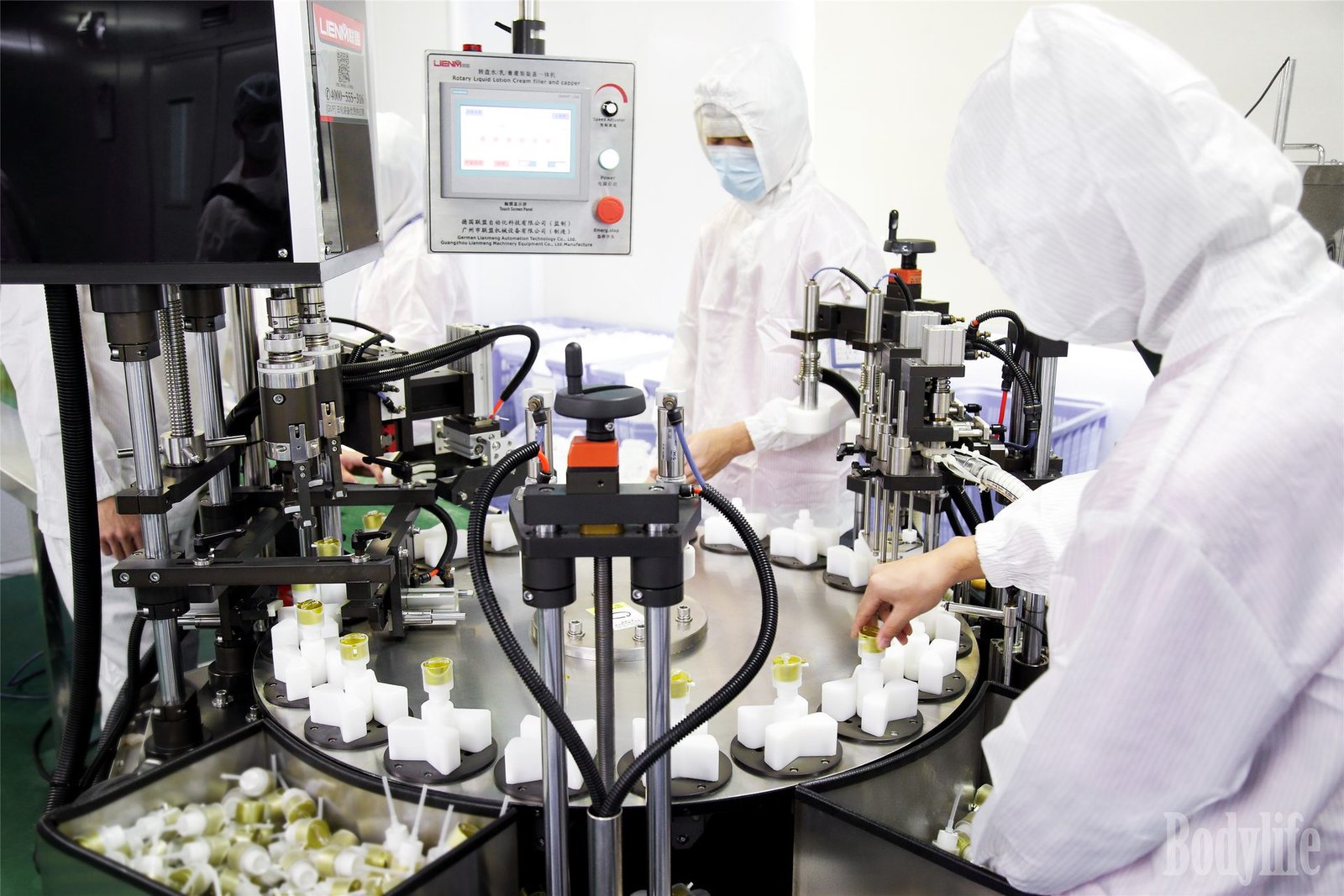
BodyLife has been manufacturing since 2002 and formulates back bar and retail as two coordinated formulas rather than one formula in two pack sizes. Both are developed in-house, and both carry their own testing file.
- Back bar and retail developed as a matched pair, with the retail concentration set for sustained home use and its own stability and microbiological data.
- Same-series concentration ladders, so a treatment protocol and its home follow-up can be designed as a set rather than assembled from unrelated SKUs.
- Custom formulation over 3–6 months, with the development fee credited against the first order.
- Fragrance-free and sensitive-skin variants — relevant for post-treatment skin and reactive clients, and for the sensitive skin private label range in particular.
- In-house R&D laboratory covering formulation, stability, microbiology and heavy metals; every batch tested with a certificate of analysis issued and full chain traceability.
- Manufacturing for spas, clinics and salons across professional channels, with OEM minimums from 500 units scalable past 100,000.
- Two GMP-certified plants, 60,000+ m² combined, 20+ production lines, annual capacity over 100 million units.
- Packaging sourced as a one-stop service including PCR material, with stock packaging supporting small orders.
- Quotation within 48 hours; sampling 7–10 days, first order 20–30 days, reorder 7–14 days.
- Eight certifications held: GMP, ISO 22716, ECOCERT, COSMOS, FDA, SMETA, CPNP, CPSR.
If you are building the retail half of a professional range from scratch, the private label face serum programme is where most protocols start, because the serum is usually the step that carries the visible result and therefore the step where the concentration decision matters most.
Frequently asked questions
Can I use back bar product as retail?
No. A back bar formula is designed for supervised, single-session use at a higher active load, and it has not been stability-tested for eighteen months on a retail shelf or for daily unsupervised application. Decanting it into retail packaging gives the consumer a product that is too strong for home use and gives the shelf a product with no supporting data. Both problems land on the brand that sold it.
Do I need two separate formulas?
If you want the treatment result to hold between appointments and you want retail revenue, yes. The two products serve different briefs: immediate visible response under professional control versus sustained daily tolerance and shelf stability. They can share a series name and a sensory family, but they need separate formulation and separate testing files.
What concentration difference is normal?
The retail formula is normally set at a lower active level than its back bar counterpart, calibrated to what a consumer can apply daily without cumulative irritation. We do not publish fixed figures because the right differential depends on the active and the vehicle, and it is established during development rather than assumed. What matters is that the differential is a deliberate decision backed by testing, not a dilution done at the filling line.
Can I build a protocol set?
Yes. We develop same-series concentration ladders so the in-clinic steps and the home follow-up are designed together as one protocol, with each SKU carrying its own stability and microbiological data. Custom formulation runs 3–6 months, and the development fee is credited against the first order.