
Organic shampoo for sensitive scalps is a formulation problem before it is a marketing claim: genuinely mild surfactants, natural preservation, and certified organic content pull against each other, and the hardest of the three by a wide margin is preservation. We have developed and manufactured more than 30 organic shampoo formulas for this combination of constraints. This page explains where the difficulty actually sits, how our formulation approach addresses it, and what evidence we can put behind the claims.
Why organic shampoo for sensitive scalps is hard to make
Three requirements collide, and resolving two usually damages the third.
Two market forces meet in this product. The global sensitive skin care market was valued at USD 44.6 billion in 2023 and is projected to reach USD 81.0 billion by 2030 (8.9% CAGR, Grand View Research), while organic personal care grows at 9.4% toward USD 44.8 billion by 2030 (Grand View Research). A formula that has to satisfy both — certified organic content and sensitive-scalp tolerance — sits at the intersection of the two hardest formulation constraints.
The mildness problem
Sensitive scalps react to surfactant systems that strip the stratum corneum faster than it can recover. Conventional sulfate surfactants clean extremely well and cost little, but they are the first thing a sensitive-scalp consumer needs removed. Replacing them is not a drop-in substitution: the replacement has to clean adequately, lather acceptably, rinse cleanly, and remain stable in a formula that may contain botanicals, proteins, and oils that all interact with the surfactant system.
The preservation problem — the real difficulty
This is where most organic shampoo projects fail. Four factors compound:
- Restricted preservative palette. Organic certification standards limit which preservatives may be used, and several of the most effective conventional options are excluded.
- Higher microbial load in the raw materials. Botanical extracts, cold-pressed oils, and essential oils arrive with a natural microbial burden that a synthetic-only formula does not carry.
- Weak intrinsic protection. Sulfate-free surfactant systems have less inherent antimicrobial activity than sulfate systems, so the preservative system carries more of the load.
- pH window. Sensitive-scalp formulas typically sit at pH 5–6 to match scalp physiology, and several preservatives are only effective at lower pH.
A formula can pass every sensory test and still fail in market if the preservative system was never challenged. This is why we treat preservation as a design constraint from the first prototype rather than a final addition.
The certification problem
ECOCERT and COSMOS certification constrain the percentage of synthetic content, the processing methods permitted for ingredients, and the acceptable preservative list. A formula that is excellent but uncertifiable cannot carry an organic claim, and reformulating for certification after development restarts stability testing.
Our formulation approach
Amino acid surfactants as the base, a specific ratio of co-surfactants to recover foam and viscosity, and a natural-origin preservation system validated by challenge testing. Each element is doing a specific job.
Amino acid surfactant base
Amino acid-derived surfactants — built on glutamic acid, glycine, or sarcosine chemistry — are chosen for three reasons: the pH of the resulting system sits close to scalp physiology, the denaturation of skin proteins is markedly lower than with sulfates, and the after-feel is not tight or squeaky. Their weaknesses are real: foam volume is lower, viscosity is harder to build, and cost per kilogram is higher.
The co-surfactant ratio
This is where formulation experience matters more than the ingredient list. Amino acid surfactants alone produce a thin, low-foam product that consumers reject regardless of how mild it is. Blending with glucoside surfactants and adjusting the ratio of the primary to secondary surfactant, together with the thickening system, recovers foam density and body without returning to sulfate chemistry. The exact ratio is formula-specific — it depends on the surfactant chain lengths, the salt content, and the actives present — and it is the part of the development that takes the most iterations.
Natural-origin preservation, validated
We formulate with natural-origin preservation systems rather than declaring the product preservative-free, because an unpreserved aqueous shampoo is a microbiological risk to the consumer, not a marketing advantage. The system is selected against the pH of the formula and the microbial load of the specific botanicals used, then validated with a preservative efficacy test — a microbial challenge that confirms the system holds under simulated consumer use.
Every organic formula we release carries preservative efficacy data. Without it, the product is not merely unverified; it is unsafe to sell.
Testing and substantiation
Claims on a sensitive-scalp product need documentation, and third-party efficacy reports are what we provide.
- Third-party efficacy reports supporting mildness and tolerance claims on sensitive scalps.
- Preservative efficacy testing per batch formula, not per batch.
- Stability testing under accelerated and real-time conditions, including compatibility with the primary packaging.
- Microbiological testing per production batch, with a Certificate of Analysis issued against specification.
- pH and viscosity verified per batch within a defined window.
What we have made
More than 30 organic shampoo formulations developed and manufactured, spanning different surfactant systems, actives, and fragrance profiles.
That volume matters for a practical reason: the failure modes are known in advance. Which botanical extract destabilises an emulsion at elevated temperature, which glucoside ratio thickens reliably at scale, which preservation system survives a pH 5.5 formula with a high essential-oil load — these are answers gained from having already made the mistake on a previous project rather than discovering it on yours.
Certifications
ECOCERT and COSMOS certification covers our organic range, and the certificate numbers and scope statements can be shared with qualified buyers under NDA, alongside GMP and ISO 22716 for manufacturing and FDA registration for US distribution.
Certification is a formulation input, not a label applied afterwards. When a client brief specifies an organic claim, the ingredient selection is constrained from the first prototype so that the finished formula is certifiable without reformulation. Facilities have been audited by retail groups in Russia and the United States as well as by ECOCERT within the past year.
Manufacturing capability
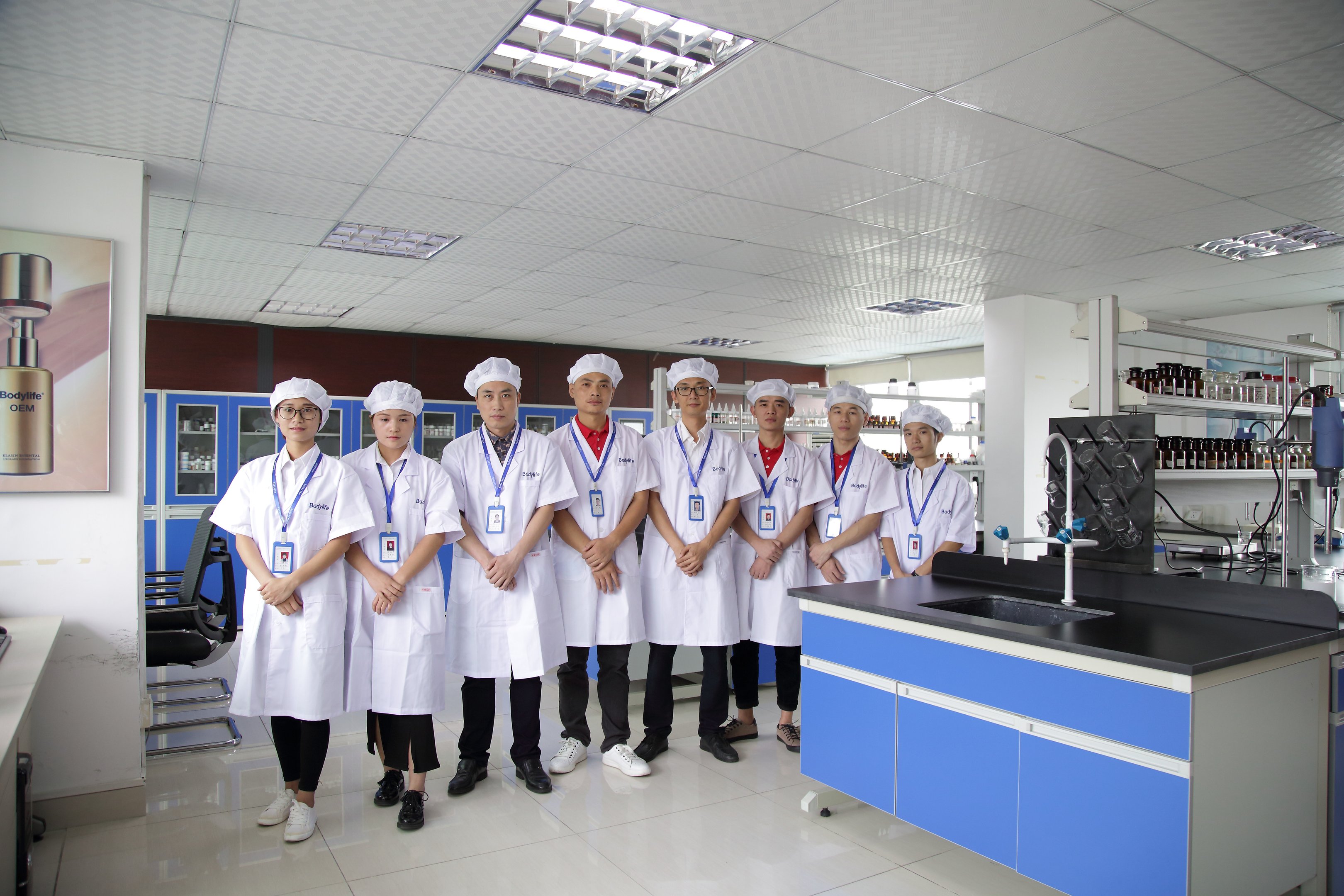
Two GMP-certified campuses totalling over 60,000 square meters, 20+ production lines, and 100 million units of annual capacity.
- MOQ: 3,000 units standard; 500–1,000 supported for early-stage brands depending on formula and packaging.
- Sampling: 7–10 days for a library formula, longer for a new organic development.
- First production: 20–30 days after sample approval and material arrival.
- Repeat orders: as fast as 7–14 days once materials are held in stock.
- Quoting: within 48 hours of a complete brief.
What we need from you
Five inputs let us quote accurately instead of estimating.
- Target claim — organic certification level required, and the specific mildness or tolerance claim you intend to make.
- Target scalp profile — sensitive, reactive, dry, or post-treatment, and whether fragrance is acceptable.
- Format and texture — transparent, pearlescent, or gel; viscosity target.
- Target retail price, which determines the surfactant and preservation tier.
- First-order quantity and target market, because regulatory scope affects ingredient selection.
The hardest part of organic shampoo
Preservation. Botanical extracts arrive with a microbial load, sulfate-free surfactants carry less intrinsic antimicrobial activity, and certified preservative options are restricted — all at a pH of 5-6 where several preservatives lose efficacy.
Frequently asked questions
Can an organic shampoo be genuinely preservative-free?
An aqueous shampoo without a preservation system is a microbiological risk, not a marketing advantage. What organic standards restrict is the list of permitted preservatives, not the requirement to preserve. We use natural-origin systems and validate them with challenge testing.
How does an amino acid surfactant shampoo lather compared to sulfate?
Less on its own. Foam density and viscosity are recovered through co-surfactant ratio and the thickening system. The result is a denser, creamier lather rather than the large-bubble foam sulfate systems produce — which most sensitive-scalp consumers accept once they understand the trade-off.
What certification do you hold for organic claims?
ECOCERT and COSMOS. Certification constrains ingredient selection and preservative choice from the first prototype, so the formula is certifiable without a later reformulation.
How many organic shampoos have you developed?
More than 30 formulations. This matters practically: the common failure modes across surfactant systems, botanical loads, and preservation at pH 5–6 are already known rather than discovered on your project.
What testing supports a sensitive-scalp claim?
Third-party efficacy reports, together with preservative efficacy testing, stability data, and per-batch microbiological testing with a Certificate of Analysis.
Next step
Send the target claim, scalp profile, and price point. The reply will state which surfactant and preservation approach fits, the certification path, and a realistic development timeline — within 48 hours.
Request a quote · Haircare manufacturing · Custom formulation
Further Reading
- We Manufacture This: Moisturizing Color-Protect Shampoo
- OEM vs ODM vs Private Label: What's the Difference?
Looking for a manufacturing partner? OEM manufacturing, private label ODM, custom formulation — get a quote within 48 hours.