Custom formulation typically takes four to eight months end to end — three to six months of that is stability testing running in parallel with iteration — across six defined stages: brief, prototype, iteration, stability and safety testing, scale-up, and first production. The timeline is driven almost entirely by stability testing, which cannot be compressed without invalidating the result. This article walks through each stage, what the brand owner must provide, and where projects actually lose time.
Custom formulation versus a library formula
Choose custom formulation when the product itself is the differentiator; choose a library formula when speed and cost dominate. A library formula with meaningful modification reaches market in weeks; a genuinely new formulation takes months.
The category is expanding quickly, which is why so much development work now targets it: the global sensitive skin care market was valued at USD 44.6 billion in 2023 and is projected to reach USD 81.0 billion by 2030, a CAGR of 8.9% (Grand View Research, 2023).
The decision usually comes down to three questions:
- Is there a claim you need that no existing formula supports? If the answer is no, a modified library formula will get you there faster.
- Is the texture or sensory profile central to the brand? If the product’s appeal is how it feels, custom development is justified.
- Do you intend to defend the formula commercially? If the recipe is the asset — to license, to sell with the brand, to protect from copycats — you need to own it, which means custom development.
Step 1 — The brief
A brief that specifies eight things cuts one to two rounds of iteration. Most delays at this stage are not the formulator’s fault; they come from a brief that leaves the target undefined.
What the brief should state:
- Category and format — serum, cream, gel, cleanser, shampoo, lotion.
- Target consumer and skin or hair type, including sensitivity constraints.
- Key claims you intend to make on pack, and whether those claims need substantiation data.
- Texture and sensory target — lightweight versus rich, matte versus dewy, fast-absorbing versus occlusive.
- Fragrance direction — or fragrance-free.
- Target retail price, which determines the formula tier and the cost ceiling per kilogram.
- Target markets, because ingredient restrictions differ between the US, EU, and Asia.
- Timeline and first-order quantity.
Step 2 — Prototype development
The formulator produces two to three prototypes from the brief, typically within three to four weeks. These are lab-scale samples, not production material, and they exist to establish direction rather than to be approved as final.
What to evaluate at this stage — and be specific, because vague feedback is the single largest cause of extra rounds:
- Spreadability and absorption rate — how it moves on skin, how long it stays tacky.
- After-feel — residue, slip, cushion.
- Colour and clarity if relevant to the format.
- Fragrance intensity and dry-down, not just the opening note.
- Immediate tolerance on the target skin type where the brand has access to testers.
Step 3 — Iteration
Most projects need two to four rounds of iteration, each taking one to two weeks. Rounds beyond four usually indicate that the brief was not specific enough rather than that the formulator is struggling.
Practical advice: consolidate feedback per round. Sending comments in three separate messages across a week adds a week. One consolidated response per prototype keeps the loop tight.
Step 4 — Stability and safety testing
This is the stage that sets the minimum project length, and it cannot be shortened. A standard stability programme runs three to six months and includes:
- Accelerated stability at elevated temperature and humidity, to predict long-term behaviour.
- Real-time stability at ambient conditions, running in parallel over the product’s intended shelf life.
- Preservative efficacy testing — a microbial challenge test proving the preservative system holds under consumer use.
- Compatibility testing between formula and packaging, which is why packaging should be selected early.
- Dermal safety assessment for the target market’s regulatory requirements.
For the EU, a Cosmetic Product Safety Report prepared by a qualified safety assessor is required before market placement; the stability and microbiological data from this stage feed directly into it.
Step 5 — Scale-up
Scale-up converts a lab formula into a production process, and this is where formulations often fail for the first time. A formula that is stable in a 1 kg lab batch may behave differently in a 500 kg production batch, because mixing shear, heating rate, and cooling profile all change.
Scale-up involves:
- Process validation — confirming the production method reproduces the lab result.
- Adjustment of processing parameters rather than formula, wherever possible.
- A pilot or first production batch sampled and tested before full release.
Where an ingredient fails under production conditions — an emulsifier that cannot tolerate the shear, a polymer that thickens unpredictably — the formulator proposes a substitution and the sample is re-run. Discovering this before bulk production is the entire purpose of the stage.
Step 6 — First production and QC release
First production runs 20–30 days after scale-up approval, and release depends on batch testing. Every batch should be tested for microbiology, preservative efficacy, pH, viscosity, and appearance, with a Certificate of Analysis issued against specification.
Release documentation typically includes the COA, the batch record reference, and the safety documentation required for your target market.
Who owns the formula
Negotiate ownership before development starts, not after. In a custom development project the brand usually owns the formula, with the manufacturer retaining process know-how. Get this stated in the development agreement, along with what happens to the formula if the relationship ends.
Ask three questions in writing: does the brand own the formula, can the brand take it to another manufacturer, and who owns the stability and safety data generated during development.
What BodyLife Global offers
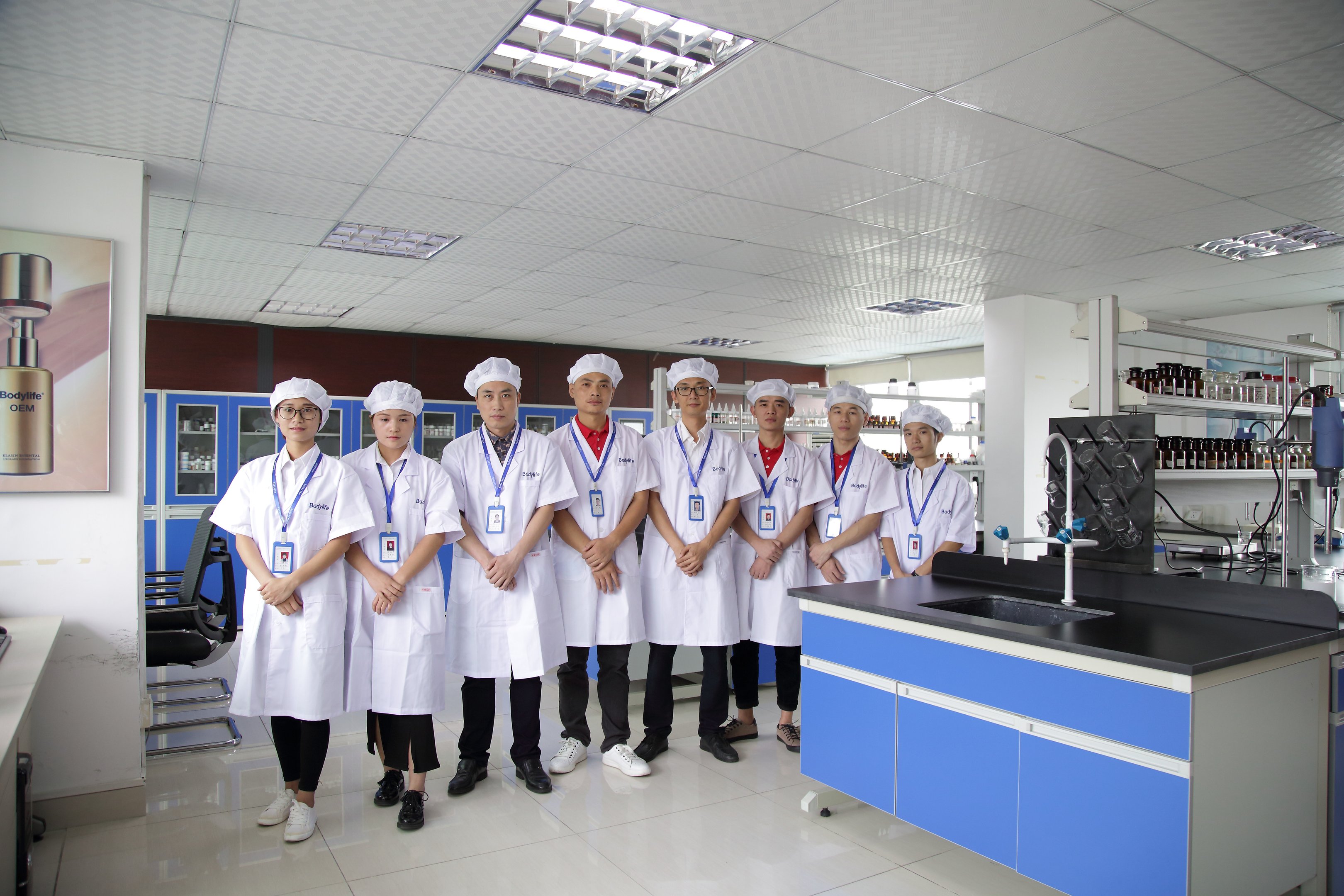
BodyLife Global runs in-house formulation development with a 20-person R&D team, a library of more than 5,000 existing formulations, and access to 1,000+ vetted ingredient suppliers. Development covers actives, botanicals, peptides, and novel ingredients, with a specific focus on gentle, hypoallergenic systems for sensitive skin and special populations.
The group operates two GMP-certified campuses totalling over 60,000 square meters with 20+ production lines and 100 million units of annual capacity, serving 300+ clients across 50+ countries since 2002.
Testing capability in-house covers stability under accelerated and real-time conditions, microbiology, preservative efficacy, pH and viscosity, and heavy metals screening. Certifications include GMP, ISO 22716, ECOCERT, COSMOS, FDA registration, and SMETA, with CPNP and CPSR documentation support.
Custom formulation typically runs three to six months from brief to production-ready formula. Development fees apply and are credited against the first production order.
The stage that sets the timeline
Stability testing. Accelerated data gives an early read, but real-time stability cannot be compressed — and launching without it transfers the risk to your brand.
Frequently asked questions
How long does custom formulation actually take?
Four to eight months end to end. Roughly one month is brief and prototyping, one to two months is iteration running in parallel with the start of stability testing, three to six months of stability testing from formula freeze, and one to two months of scale-up and first production. Roughly one month is brief and prototyping, one to two months is iteration, and three to six months of stability testing runs in parallel from the point the formula is frozen.
Can stability testing be shortened if I am in a hurry?
Accelerated testing can give an early indication within weeks, but real-time data cannot be compressed. Launching without it transfers the risk to your brand — a formula that separates on shelf in month four is a recall, not a reformulation.
What happens if the formula fails at scale-up?
The formulator proposes a substitution or a process adjustment, and the sample is re-run before bulk production is authorised. This is identified at the pilot stage precisely so it does not become a production problem.
Do I own the formula after development?
This is a contractual term, not an automatic outcome. In most custom development arrangements the brand owns the formula and the manufacturer retains process know-how. Confirm it in writing before development begins.
Next step
Bring the brief — even an incomplete one. The first response will tell you whether a modified library formula would get you there faster, which is often the honest answer.
Request a quote · Custom formulation · OEM manufacturing
Further Reading
- Launching a Skincare Brand: Real Timeline and Cost Breakdown
- Cosmetic Regulatory Compliance: US and EU Essentials for Brand Owners
Looking for a manufacturing partner? OEM manufacturing, private label ODM, custom formulation — get a quote within 48 hours.