You buy a base formula, build a brand around it, and six months later find the same base on forty other listings with different labels. The product is fine. The problem is that nothing about it is yours, and the market prices it accordingly. This is not a marketing failure. It is a structural fact about how stock formulas are developed, paid for, and resold — and until you understand the structure, you cannot price your way out of it.
What indie brand founders actually say
“The same private label line you use is also being used by others. What do you have that isn’t already out there?”
a commenter on r/Entrepreneur
“It’s a good business if you’re good at marketing and customer acquisition. If not, you’re going to wind up with a garage full of private label cosmetics.”
the same thread
These two comments are the same complaint from opposite ends. The first is about product: if the formula is shared, the only differentiator left is the label. The second is about economics: if the only differentiator is marketing, then the business is a customer-acquisition business wearing a cosmetics costume. Both are accurate, and both keep coming up because the industry keeps answering the question with the word “branding” instead of explaining where the formula cost actually sits.
Where the number actually comes from
A stock formula is a fixed development cost that has already been paid. Somebody funded the formulation work, ran it through stability chambers, checked preservative efficacy against the actual emulsion, and confirmed the packaging compatibility — all before a single sellable unit existed. That money is sunk. The only way a factory recovers it without charging any one brand the full amount is to rent the same formula to many brands. Forty listings is not a failure of the model. Forty listings is the model working as designed. If a factory sold that base to one brand exclusively, that brand would have to absorb the entire development cost, and the unit price would look nothing like what you were quoted.
A custom formula is not one cost either, and this is where most indie founders misjudge the timeline. It is formulation development first — bench work, iteration, sensory adjustment. Then stability testing, which runs in real time because you are watching an emulsion for separation, viscosity drift, and pH movement over weeks and months. Then preservative efficacy and compatibility work, because a preservative system that passes in one base can fail in yours once the active load changes. That sequence is measured in months, not weeks, and every day of it is paid before the first sellable unit exists. You are not buying a formula. You are buying the months of testing that make the formula safe to sell.
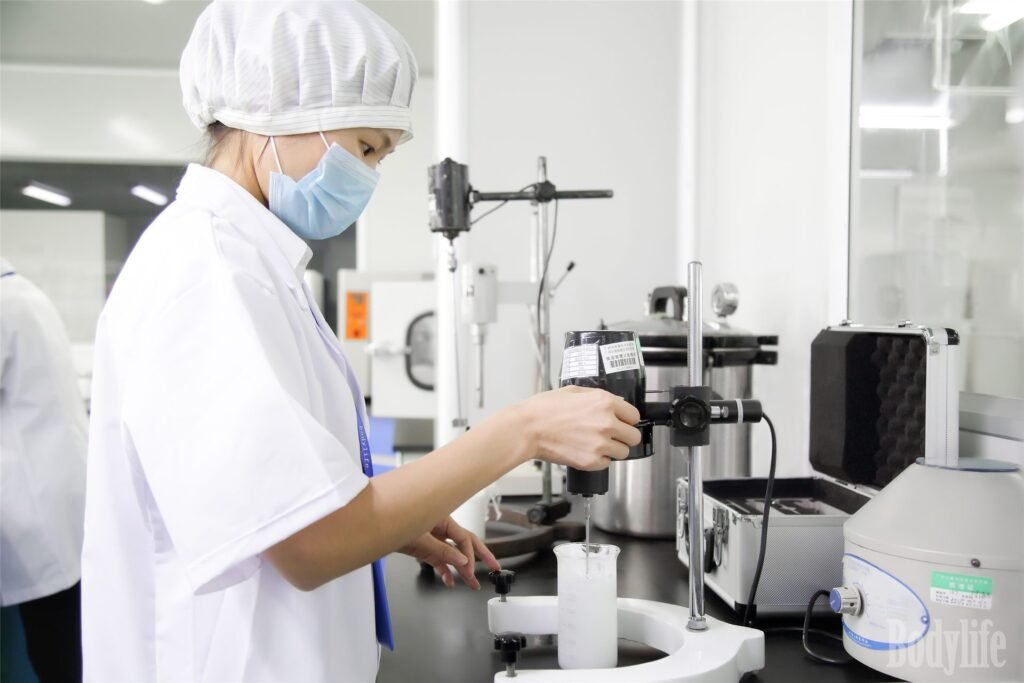
Here is the mechanism most people outside the factory never see: the expensive part of a custom project is rarely the creative formulation work. It is the testing sequence behind it. Stability and microbiological testing run on calendar time, not effort — you cannot compress a twelve-week stability read by working weekends. That is why a factory with an in-house lab quotes a very different timeline and price than one that outsources every test to a third party and adds margin and queue time on top. The lab is not a nice-to-have. It is the thing that determines whether your custom project takes three months or six.
So there are three real positions, not two. You can buy the stock base as-is and compete on brand, price, and channel. You can buy the stock base and change the active system, so the sensory and performance story becomes yours without a full development cycle. Or you can commission a full custom formula and absorb the timeline and the testing cost. The middle position is where most viable indie brands actually sit, and it is the one least discussed — because “we reformulated the active system on a proven base” is harder to put on a landing page than “custom” or “affordable”. It is also the only position that changes your cost structure without changing your launch date.
What this means if you are an indie brand
- Stop treating “shared base” as a scandal. It is a price signal. You are paying for a formula whose development cost has already been amortised, and you should price the product like it.
- Decide which axis you are actually competing on before you brief anyone: price, claim, sensory experience, or channel. A stock base can win on price and channel. It cannot win on claim.
- If your differentiator is a performance claim, the active system is the cheapest place to make it yours. Changing the active system changes the story without triggering the full testing calendar.
- Budget the testing timeline as a cost, not an inconvenience. Months of stability work are months of no revenue from that SKU.
- Ask any supplier, directly, how many brands currently buy the base you are being quoted. A supplier who will not answer is telling you something.

How we approach it
BodyLife has operated since 2002, with two GMP-certified plants covering 60,000+ m², 20+ production lines, and an annual capacity of 100M+ units. We work with 300+ active clients across 50+ countries and source from 1,000+ verified raw material suppliers. For indie and DTC brands specifically, the practical options look like this:
- A 500+ formulation library that can be shipped as-is on a short timeline, for brands that want to launch without a development cycle.
- Semi-custom work: keep a proven base and substitute the active system, so the claim and the sensory profile become distinct without a full development cycle.
- Full custom formulation over 3–6 months, with the development fee credited against the first order.
- An in-house R&D laboratory handling formulation, stability, microbiology, and heavy-metal testing, so the testing sequence is not outsourced to a third party.
- OEM minimum order of 500 units, scalable to 100,000+, with stock packaging that supports small orders and one-stop packaging sourcing including PCR material.
- Quotation within 48 hours; sampling in 7–10 days; first order in 20–30 days; reorder in 7–14 days.
- Every batch tested with a certificate of analysis issued and full chain traceability.
If you are working on a private label face serum, the active system is usually where the differentiation lives, and it is the most straightforward semi-custom conversation to have. A private label face cream is more often a base-and-sensory question, where the emulsion texture carries more of the brand story than the active load. Either way, the decision is the same: which of the three positions are you actually buying? Our indie and DTC manufacturing work is built around answering that before a quote is issued.
Frequently asked questions
Is a stock formula a bad thing?
No. A stock formula is a development cost that has already been paid and amortised across many brands, which is why it is affordable and why it ships quickly. It is a bad thing only if you are trying to compete on a performance claim the base cannot support. If you are competing on price, channel, or brand, a stock base is the rational choice.
What counts as semi-custom?
Semi-custom means keeping a proven base formula and substituting the active system, so the claim and the sensory profile become distinct without a full development cycle. You inherit the base’s existing stability and compatibility work while changing the part of the formula that carries your story. It sits between buying as-is and commissioning a full custom formula, and it is where most viable indie brands land.
How long does a fully custom formula take?
Three to six months, driven mainly by stability and preservative efficacy testing that runs on calendar time rather than effort. Formulation development comes first, then stability, then microbiological and compatibility work. At BodyLife the development fee is credited against the first order, so the cost is recovered rather than lost.
Can I own a formula exclusively?
Exclusivity is a commercial term, not a technical one, and it has to be negotiated explicitly rather than assumed. A stock base sold to many brands cannot be made exclusive retroactively. A full custom formula commissioned by you is the cleanest route to exclusivity, because the development cost is carried by your project rather than amortised across the market.