Decide this before artwork is signed off, not after: for every sentence you intend to print, what evidence actually sits behind it — and does that evidence describe the finished product, or only a raw material inside it? That one distinction separates claims that hold up under review from claims that force a reformulation, a reprint, or a quiet withdrawal from the market.
Three tiers of evidence, not two
Claim reviews usually collapse into a binary: we can say it, or we cannot. In practice there are three tiers, and most disputes happen in the middle one.
- Tier 1 — finished-product data. A study run on the exact product being sold, measuring the endpoint named in the claim over the timeframe named in the claim. Instrumental measurements (corneometry for hydration, transepidermal water loss for barrier function, profilometry or expert grading for wrinkles) or a supervised consumer panel. A time-bound efficacy sentence needs this tier.
- Tier 2 — ingredient literature. Published work on a raw material, typically at the concentration that study used. This supports a statement about an ingredient. It is the tier most often mistaken for product substantiation.
- Tier 3 — mechanistic and in-vitro data. Cell culture, ex-vivo skin, model systems. Useful for narrowing a development direction and for internal confidence; on its own it rarely carries a consumer-facing efficacy claim.
The failure mode is predictable. A raw material supplier hands over a dossier of tier-2 and tier-3 studies; the dossier is filed as “support”; a tier-1 sentence gets printed. When a reviewer asks for the study behind visibly firmer in 7 days, the dossier answers a different question — sometimes rigorously, always irrelevantly.
The claim types challenged most often
None of these are impossible to make; all require the evidence to match the sentence, word for word.
- Time-bound efficacy. Wrinkles reduced in 4 weeks. Visibly firmer in 7 days. The timeframe in the sentence must be a timeframe that was actually measured on the finished formula. Twelve-week ingredient data cannot support a seven-day product claim, and this mismatch is the easiest thing for a reviewer to find.
- “Clinically proven.” Two words that invite a request for the protocol: who ran it, on how many subjects, against what endpoint, with what control. If the honest answer is that the ingredient was clinically proven, the sentence is describing a raw material, not your product.
- “Dermatologist tested” and “hypoallergenic.” Both describe a test, not an outcome, and neither term defines itself. “Dermatologist tested” is only as strong as the protocol and report behind it. “Hypoallergenic” has no harmonised definition in most major markets, and where it is treated as an absolute claim, no formula can honestly carry it.
- “Non-comedogenic.” Properly, this rests on a comedogenicity study, usually on human subjects. It is very often asserted from the ingredient list instead — no known comedogens in the formula, therefore non-comedogenic. Those are not the same statement, and the second one is not evidence.
- “Clean”, “non-toxic”, “chemical-free.” Marketing frames with no legal definition. “Chemical-free” is simply false for any cosmetic: water is a chemical. The class carries a second risk that matters more — it implies a safety comparison with unnamed competitor products, which is where most challenges actually begin.
- Disease and drug-adjacent language. Treats eczema. Clears acne. Repairs the barrier. The last one sits close to a boundary that moves depending on the market. In the US, structure-function language and drug claims are different categories; in the EU, claims must be supported by adequate and verifiable evidence for the finished product. Copy written for one market and pasted into another is a recurring source of trouble.
No public, industry-standard figure exists for how many claims fail review, and percentages quoted by agencies are self-reported. The useful measure is whether a specific sentence has a specific document behind it.
The one distinction that matters
An ingredient dossier proves what a raw material did in a study on that raw material. Once it is inside your base, at your pH, in your pack, the burden of proof moves to the finished product — and almost nobody checks that the move happened.
Where the documents actually come from
Substantiation is not one file. It is a set of documents produced at different stages by different parties.
- Stability report — in-house lab. Accelerated and real-time data covering shelf life, texture, colour, and packaging compatibility.
- Preservative efficacy (challenge) test — in-house or an external microbiology lab. Supports both the safety file and any “preservative-free” positioning.
- Per-batch testing and Certificate of Analysis — in-house. Microbial limits, heavy metals, and identity/assay where relevant, with full-chain traceability from raw material lot to finished batch.
- Packaging compatibility — in-house. The claim and the pack have to agree; a stability claim that ignores the pack is only half a claim.
- Human efficacy or consumer panel study — usually an independent contract research organisation, because the design needs blinded subjects and independent grading.
- Restriction-list screening for target markets — the formulation team, country by country, before the formula is frozen.
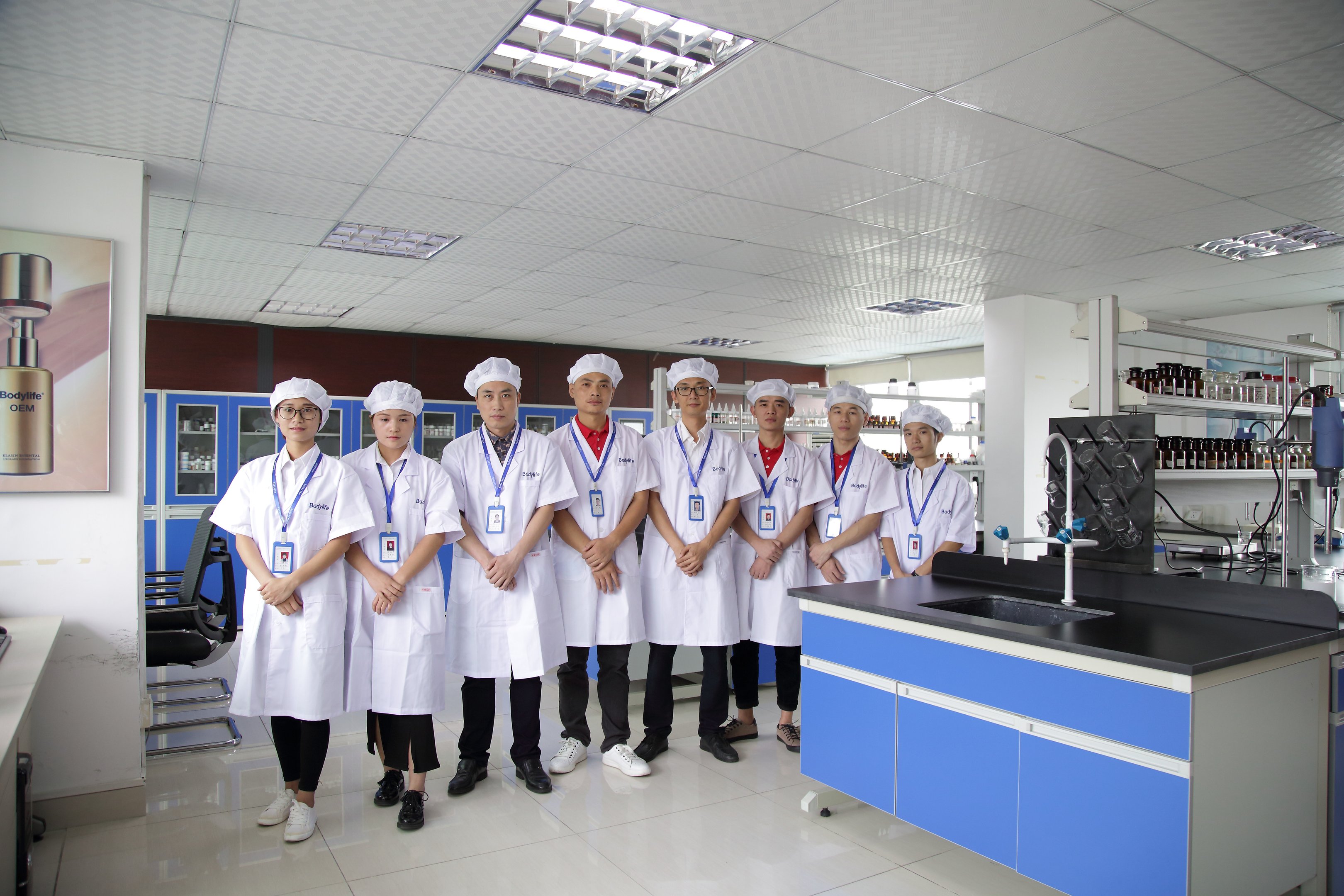
When a manufacturer describes its laboratory, the specific list matters more than the adjective. Formulation, stability, microbiology, and heavy metals is a normal in-house scope; a claim to run blinded clinical trials in-house deserves one follow-up question — who grades the subjects?
Why the formula decides the claim, not the copy
The expensive discovery is that a sentence was never available in the first place, because the formula foreclosed it months earlier.
Active concentration and pH. An exfoliation claim built on an acid is really a pH claim. If pH is set for stability rather than for efficacy, the sentence and the formula have quietly separated. Finding that at copy stage means reformulating and restarting stability — the two most expensive words in this article.
Preservative architecture. “Preservative-free” is not a marketing line; it is a structural decision involving water activity, pH, packaging, and challenge testing. Claiming it after the base is finalised usually means changing the base.
Packaging. A vitamin C efficacy claim and an opaque airless pack are one decision, not two. The same formula in a jar is a different product with a weaker claim, and no amount of copy repairs that.
Development time is substantiation time. Custom formulation typically runs 3–6 months, with the development fee credited against the first order, because stability and compatibility testing sit inside that window. Sampling in 7–10 days is a sample; first production runs 20–30 days; repeats 7–14 days. Only the first number is often mistaken for evidence.
Six questions to run against copy you have already written
- Does the sentence describe an outcome or a test? “Tested” answers a different question from “reduced”.
- Does the timeframe in the sentence appear in the study? Seven days in copy, twelve weeks in the report, is a mismatch, not a rounding error.
- Was the study run on the finished product or on a raw material? If nobody can answer without checking, assume tier 2.
- Would a competitor’s product make the same sentence? If yes, it is a category claim, not a differentiator — and those are the ones reviewers see most often.
- Does any word imply treatment of a disease? Read the sentence as a regulator would, not as a customer would.
- Does the claim survive a pack change? If switching from airless to a jar kills it, the claim belonged to the pack.
What to ask a manufacturer before you print
The questions are short, and the answers separate suppliers quickly.
- Send the claims substantiation file, not the ingredient brochure — and state which sentence each document supports.
- Which tests are in-house and which are outsourced, and who signs the report?
- Was the formula screened against the restriction lists of every market on the label? Screening after freeze is a reformulation.
- What is the packaging compatibility position for this claim, in this pack?
- What happens to the claim if the format changes — tube to jar, pump to dropper?
- Can every batch be accompanied by a Certificate of Analysis with traceability from raw material lot to finished batch? 25 years of production, two GMP sites, and 300+ active clients across 50+ countries is a reasonable basis for that discipline; a supplier who cannot produce the paperwork is telling you something.
Frequently asked questions
Can an ingredient supplier’s study support my product claim?
Generally not on its own. Ingredient studies describe a raw material under specific conditions. They support a statement about that ingredient, and they become useful for a product claim only when paired with finished-product data showing the ingredient is present, available, and stable in your formula.
Is “dermatologist tested” enough on its own?
It documents that a test occurred, not what it found. The phrase should be backed by a named protocol and a signed report, and it should not be used to imply an efficacy result that was never measured.
Do I need a clinical study for every claim?
No. Hydration and barrier function can rest on instrumental measurements; sensory and preference claims can rest on a consumer panel. Time-bound efficacy, comparative claims, and anything using “clinically proven” need human data on the finished product.
Who owns the substantiation file — the brand or the factory?
In most markets the brand is the responsible party and must be able to produce the file on request. The manufacturer generates most of the technical content — stability, microbiology, per-batch testing, compatibility — so the practical answer is that the factory builds it and the brand holds it.
Can claims be fixed after launch?
Yes, but the cost curve is brutal: changing copy means new artwork, new labels, and often a new pack run; changing the formula means new stability and restarting the clock. Both are cheap before the formula is frozen and expensive afterwards.
Next step
Send the brief with your target markets and the three claims you most want to keep. The reply flags which of them the formula can support as written, which need rewording, and which need a study — and it arrives within 48 hours. Custom formulation at BodyLife runs with an in-house R&D lab covering formulation, stability, microbiology, and heavy metals, under GMP, ISO 22716, ECOCERT, COSMOS, FDA, SMETA, CPNP, and CPSR scope.
Read next: US and EU cosmetic regulatory compliance and what GMP and ISO 22716 actually mean for your brand. Service pages: custom formulation, certifications, and OEM manufacturing.