A three-day sample and a six-month production run are usually the output of the same shortcut. That is the decision this article helps you make: not which formula to choose, but whether the timeline a supplier quotes can survive contact with a filling line, a stability chamber and a customs declaration. Below is what actually happens between an approved brief and a bulk shipment, where weeks disappear, and how to build a launch calendar with enough buffer to absorb one round of rework.
The sample is the cheapest thing a factory will ever send you
A first prototype costs a factory a few hundred grams of material and a technician’s afternoon: no filling line, no packaging run, no stability data, no documentation package. That is why a 7–10 day sample turnaround is realistic at a plant running 20+ production lines — the sample never touches most of the plant.
The mistake brands make is reading that number as a speed indicator for the whole project. A sample produced outside the production environment answers “does this texture and scent feel right?” It does not answer “will this survive twelve months on a shelf, three weeks in a container, and a filling nozzle at line speed?” Those are different questions, answered by different equipment, and they cannot be answered in a beaker.
Six gates, and only one of them is about the formula
Custom formulation typically runs 3–6 months from brief to production-ready bulk. That window is not a queue; it is the sum of gates that each have their own clock.
| Gate | What it actually decides | Typical duration |
|---|---|---|
| Brief and feasibility | Whether the claim, the price band and the pack format are compatible at all | Inside the 3–6 month window |
| First prototype | Texture, scent, colour, initial skin feel | 7–10 days from approved brief |
| Iteration rounds | Which variable you are willing to trade — you rarely get all of them | Inside the 3–6 month window |
| Stability and pack compatibility | Whether it is still the same product in month 12, inside your actual pack | Its own clock — the long pole of the window |
| Microbiology and heavy metals | Whether the preservative system holds under real use; whether the batch can be released | In-house, inside the window |
| Filling trial / scale-up | Whether the formula behaves at line temperature and line speed | Before bulk release |
| First production | Bulk manufacture, filling, QC, COA | 20–30 days |
| Repeat order | Same formula, same pack, new batch | 7–14 days |
Note what is mostly absent from the duration column: no industry-standard benchmark exists for most of these gates, and the precise figures published on manufacturer websites are self-reported and usually describe the best case rather than the median. The honest answer is that it depends on the system — an anhydrous balm and an unstable emulsion with 8% active do not share a clock. The process itself is documented step by step in Custom Formulation: From Brief to Bulk in 6 Steps.
Where the calendar actually breaks
Projects rarely lose weeks at the stage everyone worries about. They lose them at the seams. Five failure points account for most of the delay:
1. The emulsion that was fine on the bench and separates at filling temperature. Lab mixing runs at small volume with gentle shear; a line pumps, holds and fills at a different temperature profile with a different residence time. A system near its stability boundary holds in a beaker and breaks in a 500 kg tank. This is the most common scale-up rework, and it is invisible until the filling trial.
2. The formula that passes stability and fails the preservative challenge. Clean positioning, low pH and surfactant-heavy systems all constrain which preservatives can be used, and how much. A formula can be physically stable for a year and still fail efficacy — and because that test runs late, failure sends you back to reformulation with the calendar already spent.
3. Packaging compatibility discovered after the packaging is ordered. A pump that doses a thin lotion correctly will choke on a 40,000 cps cream. A tube lining can interact with a high-oil fill. PCR resin introduces colour variation that a rigid standard will reject. Packaging is a one-stop function here — stock packs, custom moulds and PCR materials — but compatibility has to be tested with the actual pack.
4. Claims that require certification, not just a formula. Organic positioning on ECOCERT or COSMOS terms constrains the entire ingredient list, preservatives included, from the first prototype rather than at the label stage. EU entry needs a CPSR and a CPNP notification, both of which run on documentation that must exist before submission.
5. Artwork locked after bulk. The cheapest delay to prevent and the most common to cause. If carton copy is still moving while bulk is being filled, finished goods sit in a warehouse waiting for a print run.
What a 72-hour sample usually skipped
A sample delivered in three days is not a faster version of a ten-day sample; it is a different artifact. In practice it has almost always skipped four things:
- Stability, entirely — no accelerated data, no real-time data, no answer to what happens at 40°C in July.
- Preservative efficacy testing — the sample is fresh, not challenged.
- Pack compatibility — it arrived in a generic jar, not your pack.
- Line conditions — hand-filled, small batch, no residence time, no nozzle.
None of that makes a fast sample useless. As a concept check — is this the texture we want, does this scent read the way we described it — it is efficient and costs the factory almost nothing. The problem starts when a fast sample is used to set a launch date. The four skipped items do not disappear; they move to after the purchase order, where they are far more expensive to discover.
The one line to remember
A sample tells you whether the concept is worth pursuing. Only the test data tells you whether the product can be sold — and the two arrive on different schedules by design, not by incompetence.
Building a launch calendar that survives one rework
Budget one iteration round inside the 3–6 month window, not after it. A plan that assumes the first prototype is approved is a plan for the best case. A plan that assumes one rework finishes on time when the optimistic plan finishes late.
Lock packaging against a tested pack, before bulk. Stock packaging supports small first runs and removes the tooling clock entirely — useful when the first order is in the low thousands. Custom moulds buy differentiation and add a timeline that has nothing to do with the formula.
Match cash to gates, not to the calendar. Standard terms are 30/70 or 40/60, balance against production. MOQ starts at 500 units and scales to 100,000+, so money committed at the sample stage is a development fee credited against the first order, not a bet on inventory. A full cost model by stage is set out in Launching a Skincare Brand: Real Timeline and Cost Breakdown.
Sanity-check the price band before the formula is written. The band you target — under $1, $1–2, $2–3, or above $3 per unit — determines which ingredient grades, which pack and which test set are viable. A brief written for a sub-$1 unit price with an ECOCERT ingredient list is not a negotiation problem; it is a contradiction discovered at quotation.
What to ask before the first sample
These questions cost nothing and separate a supplier that can carry a launch from one that can only produce a beaker:
- Which tests ship with the sample, and which only with bulk?
- Is the sample hand-filled, or drawn off a line trial?
- Who runs stability and microbiology — in-house or outsourced — and can the protocol be reviewed?
- Has this formula been tested in the pack we intend to use?
- What happens on a stability or challenge failure, and who pays for the reformulation round?
- Is the development fee credited against the first order?
- What documentation accompanies each batch — COA, traceability records, which certifications?
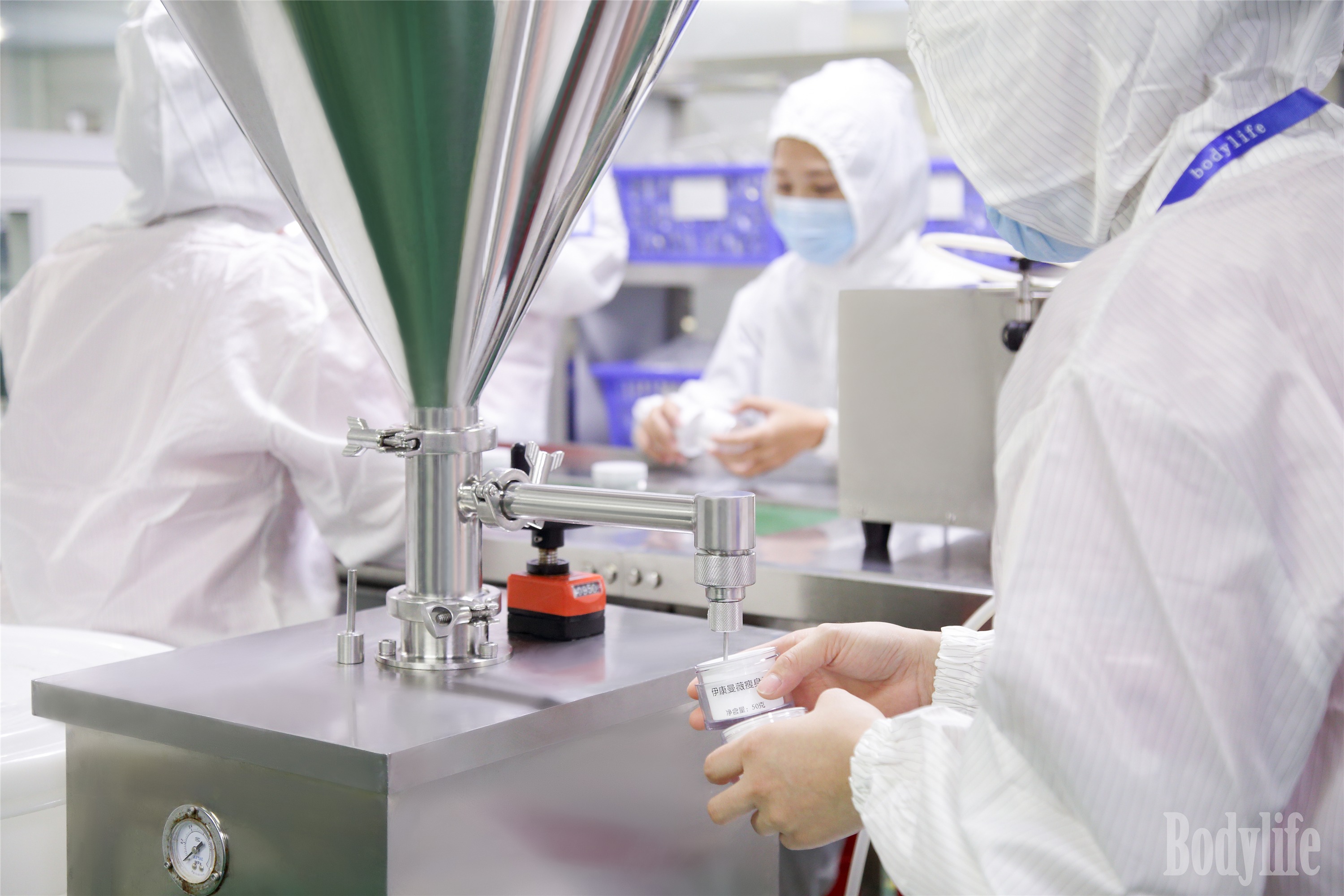
At BodyLife, formulation, stability, microbiology and heavy metals screening all run in the in-house R&D lab across two GMP sites totalling 60,000+ sqm, with 1,000+ verified raw material suppliers behind the ingredient list. Every batch is tested, released with a COA, and traceable through the chain. That infrastructure is why custom development takes 3–6 months rather than six weeks — the tests are the product, not an optional extra. Certification coverage spans GMP, ISO 22716, ECOCERT, COSMOS, FDA registration, SMETA, CPNP and CPSR.
Frequently asked questions
How long from approved sample to a bulk shipment?
Once bulk is approved, first production runs 20–30 days: manufacture, filling, QC and COA. The variable is the approval itself, which happens only when stability, microbiology and pack compatibility data support it. Repeat orders on an unchanged formula and pack run 7–14 days.
Can custom formulation be compressed below three months?
Only by removing testing, which does not remove the risk — it transfers it to your brand. A formula can be written in days. What takes months is proving it holds. A supplier offering a fully custom formula in six weeks is either skipping those steps or reusing a library base.
Is a library formula faster, and is it worse?
Faster, and not necessarily worse. A library base with meaningful modification is right when speed and cost dominate. Custom development earns its 3–6 months when the claim, texture or active level has no existing formula behind it.
What does the development fee cover?
Formulation work, prototyping and the testing that runs alongside it. It is credited against the first production order rather than refunded, so the effective cost falls to zero if the project ships. MOQ on that order starts at 500 units and scales to 100,000+.
Next step
Send the brief even if it is incomplete — a target price band, a claim, a pack idea and a launch window are enough to start. A quotation within 48 hours will show which gates apply, what each costs, and where the timeline realistically lands. That is a more useful document than a sample arrival date, because it is the one you can plan a business around. Start at Get a Quote, or review custom formulation, OEM manufacturing and packaging solutions first.